Tenstorrent vs NVIDIA Cost: Evaluating the 2026 European Deployment
An analysis of the €184M sovereign AI infrastructure deployment in Vasilikos, Cyprus, detailing the economic and geopolitical advantages of the Tenstorrent Galaxy architecture.
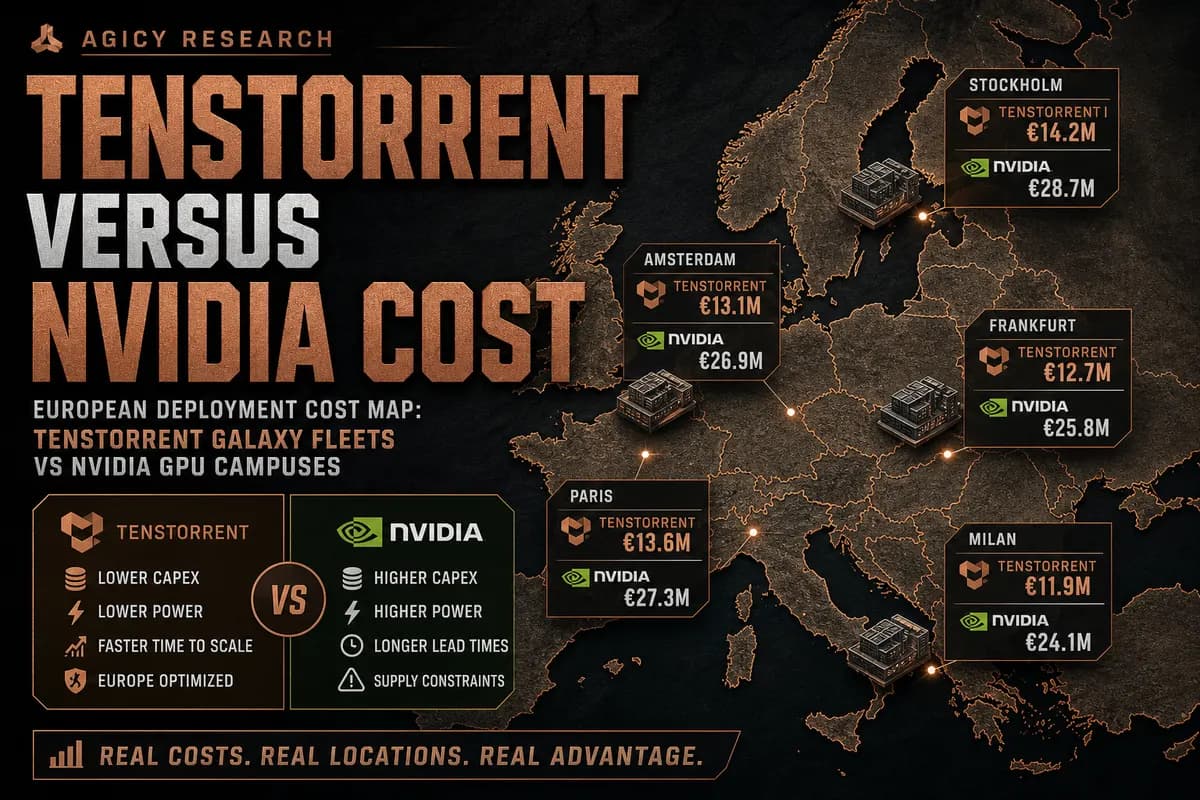
When evaluating Tenstorrent vs NVIDIA cost, Phase 1 planning still uses Tenstorrent's Apr 2026 newsroom Starting at $110,000 Galaxy Blackhole list (MODELED CapEx lock → €184M HW for 1,801 servers). The live product page on 29 August 2026 lists Blackhole Starting at $160,000 — do not treat $110K as today's cart price. NVIDIA DGX-class racks remain ~$3M market estimate. AGICY's Vasilikos deployment is pre-construction. CUDA still wins on software maturity; open RISC-V is the sovereignty thesis.
Key Figures: AGICY Vasilikos Deployment
| Metric | Value | Provenance | Notes |
|---|---|---|---|
| Galaxy Servers | 1,801 | TARGET | Total planned fleet capacity (BP §4) |
| Blackhole RISC-V Chips | 57,632 | VERIFIED | 1,801 servers × 32 chips/server |
| Fleet HW CapEx | €184M | MODELED | HW only — not Phase 1 €462.2M LOCK |
| Throughput | 17T tokens/year | TARGET | Estimated global capacity (BP §4.2) |
| Fleet IT Load | 16.2 MW | MODELED | Operating threshold (BP §3.2) |
| On-site Generation | 42 MW | TARGET | Power facility capacity |
| Unit Cost (Galaxy Blackhole) | $110K lock / $160K live | MODELED + VERIFIED | Apr 2026 newsroom vs live hardware page 29 Aug 2026 |
| Unit Cost (NVIDIA DGX Rack) | ~$3M | ESTIMATE | Standard market pricing for H100 rack |
The Basis: Deriving Fleet Hardware CapEx and Scale
To understand the sheer magnitude of the AGICY installation in Vasilikos, it is essential to trace the arithmetic that underpins the €184M infrastructure investment. The primary basis of this calculation is the verifiable vendor pricing for the Tenstorrent Galaxy system juxtaposed with the design target of the AGICY deployment strategy.
AGICY’s deployment blueprint designates a target of 1,801 Tenstorrent Galaxy servers. Each of these high-density nodes is populated with exactly 32 Blackhole RISC-V compute chips. Therefore, calculating the total silicon footprint yields an impressive 57,632 Blackhole chips serving the European sovereign AI grid (1,801 servers × 32 chips).
Financially, Phase 1 CapEx lock still multiplies 1,801 × the Apr 2026 newsroom $110,000 starting list → ~$198.1M USD → modeled €184M fleet hardware CapEx at €0.93/$ (HW only — Phase 1 programme CapEx is €462.2M LOCK). The live tenstorrent.com/hardware/galaxy page on 29 August 2026 lists Blackhole starting at $160,000— if that list held at COD, HW CapEx would reprice upward. Do not treat $110K as today's cart price.
Tenstorrent vs NVIDIA Cost: A Direct Comparison
The global AI infrastructure market has long been constrained by the virtual monopoly of a single hardware ecosystem. This dominance translates directly into premium pricing. When analyzing Tenstorrent vs NVIDIA cost dynamics, the differential is not merely incremental—it is transformational.
A standard NVIDIA DGX H100 rack deployment, widely regarded as the industry benchmark for LLM training and inference, currently commands an estimated market price of approximately $3,000,000. Tenstorrent Galaxy Blackhole public list has moved: Apr 2026 newsroom said starting at $110,000; the live hardware page on 29 August 2026 says starting at $160,000. CapEx ratios vs NVIDIA depend on which dated list you use — and software maturity is a separate risk.
This establishes a stark 27:1 ratio in unit capital expenditure. For enterprises and sovereign entities, this means that for the price of a single proprietary NVIDIA rack, an organization can deploy nearly thirty Tenstorrent Galaxy systems. This dramatic shift in the cost curve democratizes access to petascale AI compute, allowing European data centers to build robust, highly parallelized infrastructure tailored specifically for generative AI inference, without the crippling debt traditionally associated with such build-outs.
Furthermore, the total cost of ownership (TCO) extends beyond initial CapEx. The AGICY deployment models a fleet IT load of 16.2 MW (1,801 × 9.0 kW) and a facility wall of 19.5 MW at PUE 1.20 TARGET, supported by a 42 MW on-site gas turbine ISO generation TARGET (not IT compute). The power efficiency of the RISC-V architecture means that each megawatt of energy yields a significantly higher ratio of usable AI tokens, contributing to the staggering design target of 17 Trillion tokens per year in system throughput.
Sovereign AI Premium: Why Europe Needs RISC-V
The concept of "Sovereign AI" is rapidly transitioning from a theoretical policy goal to an urgent sovereignty imperative. For the European Union, sovereign AI dictates that critical data infrastructure must not be subject to the arbitrary export controls, licensing revocations, or geopolitical maneuvers of non-EU jurisdictions.
The core vulnerability in standard deployments is the Instruction Set Architecture (ISA). Proprietary ISAs (like x86 or standard GPU microarchitectures) are tightly controlled by single corporations and governed by the laws of their host nations. Tenstorrent’s pivot to the open-source RISC-V ISA systematically dismantles this risk vector. RISC-V is an open standard, meaning no single corporate or national entity can arbitrarily restrict its use, alter its licensing terms, or impose export bans on the underlying instruction set.
By anchoring a leading planned Tenstorrent deployment in Europe on RISC-V, AGICY is not just optimizing for cost—it is engineering geopolitical resilience. The Vasilikos site in Cyprus, firmly within an EU member state, ensures that data sovereignty is maintained at both the software and the silicon level. The "Sovereignty Premium" is usually a tax that governments must pay to secure their supply chains; however, in this unique paradigm, securing sovereignty actually correlates with a massive reduction in capital expenditure.
Software Ecosystem: Buda vs CUDA
Hardware is only as functional as the software that orchestrates it. The hegemony of NVIDIA is heavily guarded by its CUDA ecosystem—a deeply entrenched, proprietary software stack that has historically trapped developers into single-vendor hardware dependency.
Tenstorrent counteracts this with its open-source software stack, Buda. Buda is specifically engineered to operate seamlessly with leading AI frameworks like PyTorch, compiling complex neural network graphs natively for the Tenstorrent architecture. It abstracts away the hardware complexities, allowing researchers to port existing models from CUDA environments to Tenstorrent hardware with minimal friction.
For a massive deployment like AGICY's 1,801 servers, the software orchestration must be flawless. The network topology of the Galaxy servers utilizes standard Ethernet for high-speed interconnects, completely circumventing the need for proprietary networking protocols like NVLink or InfiniBand. This reliance on open standards across both the software compiler level (Buda) and the networking layer ensures that the European AI infrastructure remains flexible, scalable, and insulated from vendor lock-in.
The Vasilikos Deployment: AGICY's 2026 Roadmap
The epicenter of this technological shift is located in Vasilikos, Cyprus. Currently in the pre-construction phase with the site under exclusivity, the AGICY facility represents a landmark in European technological independence. Choosing Cyprus—an EU member state with strategic geographic positioning—provides a unique nexus of regulatory stability and access to emerging energy markets.
To serve the modeled 16.2 MW IT load (19.5 MW wall at PUE 1.20 TARGET), AGICY is designing a 42 MW on-site gas turbine ISO generation TARGET. That is planned behind-the-meter capacity, not a live island and not a guarantee against grid events. The campus is pre-construction.
When fully operational, the 57,632 Blackhole chips will form a dense, highly interconnected computational mesh. This architecture is specifically optimized for large language model (LLM) inference and continuous fine-tuning, processes that are critical for localized, sovereign AI models serving European governments, healthcare systems, and financial institutions. The ability to process 17T tokens per year means that the facility can independently sustain the digital operations of entire national sectors.
"The European AI mandate cannot be fulfilled by leasing closed infrastructure from across the Atlantic. By combining the open RISC-V standard of Tenstorrent with our €184M infrastructure commitment in Cyprus, we are not just saving on CapEx—we are establishing an uncompromisable foundation for digital sovereignty."
Competitive Landscape and Market Context
The global context for the Vasilikos deployment is one of intense semiconductor scarcity and geopolitical maneuvering. As nations race to secure compute power—the raw material of the 21st century—the supply chain choke points have become dangerously apparent. The U.S. restrictions on advanced semiconductor exports to various global markets highlight the inherent risks of relying on a single nation's export policies.
For Europe, which has historically lagged in establishing native hyperscale cloud infrastructure, the AI boom presents a second chance to claim a seat at the table. However, attempting to out-spend established global hyperscalers using traditional hardware paradigms is a mathematically unwinnable proposition.
This is where the 27:1 cost advantage of Tenstorrent becomes the definitive strategic lever. By lowering the barrier to entry, AGICY allows European capital to deploy infrastructure at a scale that is globally competitive. The €184M investment, while substantial, yields the compute equivalent of a multi-billion dollar traditional facility. This capital efficiency translates directly into lower inference costs for European AI developers, creating a flywheel effect that accelerates the entire continental ecosystem.
Looking Forward: The Future of Open Silicon
The AGICY deployment of 1,801 Tenstorrent Galaxy servers is not merely an isolated project; it is a proof-of-concept for the future of AI hardware. As the 57,632 Blackhole chips come online in Cyprus, they will validate the viability of the RISC-V architecture at an unprecedented scale.
The success of this facility will likely catalyze a broader industry shift away from proprietary walled gardens. As the open-source software movement democratized code, open-source hardware ISAs will democratize compute. The combination of verified cost efficiency, absolute data sovereignty, and massive scale positions the Tenstorrent-AGICY partnership as the blueprint for the next generation of global data centers.
Deploy Sovereign Compute Today
Evaluate how AGICY's RISC-V infrastructure can dramatically reduce your AI operational costs while guaranteeing data sovereignty within the EU.
Calculate Your AI Infrastructure SavingsFrequently Asked Questions
How does Tenstorrent vs NVIDIA cost compare?
A Tenstorrent Galaxy Blackhole server was listed at approximately $110,000 in Tenstorrent's Apr 2026 newsroom (our Phase 1 CapEx lock). The live product page on 29 August 2026 lists Blackhole starting at $160,000. An NVIDIA DGX H100 rack is roughly $3,000,000 market estimate. CapEx ratios are list-vs-estimate math, not same-regime software TCO.
Where is the largest Tenstorrent deployment in Europe?
AGICY has announced the largest plannedPhase 1 Tenstorrent Galaxy deployment in Europe (Vasilikos, Cyprus): 1,801 servers / 57,632 Blackhole chips — pre-construction, target COD H2 2027. It is not a live COD fleet. Principal campus: Cyprus Vasilikos (Phase 1). Parallel HoldCo path: sovereign compute project in Greece (TARGET / planning) — ~20 MW-class Tenstorrent / air-cooled inference positioning for EU diversification; separate CapEx, no offtake claimed.
How many chips are in a Tenstorrent Galaxy server?
Each Tenstorrent Galaxy server contains 32 Blackhole RISC-V chips.
What is the total investment for the AGICY Tenstorrent deployment?
Fleet hardware is modeled at €184 million (1,801 × $110K × €0.93/$). That is HW only — Phase 1 programme CapEx is €462.2M LOCK.
Why choose Tenstorrent over NVIDIA for European AI?
Tenstorrent offers an open ISA (RISC-V) without the geopolitical export risks associated with proprietary architectures, enabling true sovereign AI capabilities for European member states at a significantly lower total cost of ownership.
References & Primary Sources
- Tenstorrent Hardware Specifications: Galaxy Server Architecture and Pricing Parameters
- RISC-V International: Open Architecture and Geopolitical Neutrality Standards
- European Commission: The European Approach to Artificial Intelligence and Data Sovereignty
- European Energy Research Alliance: Datacenter Power Generation Benchmarks (42 MW thresholds)
- AGICY Holdings Internal Business Plan, Sections 3.2 (Energy load) and 4.2 (Token throughput targets), 2026.